
Purpose in life based on daily activities
RESEARCH BRIEF
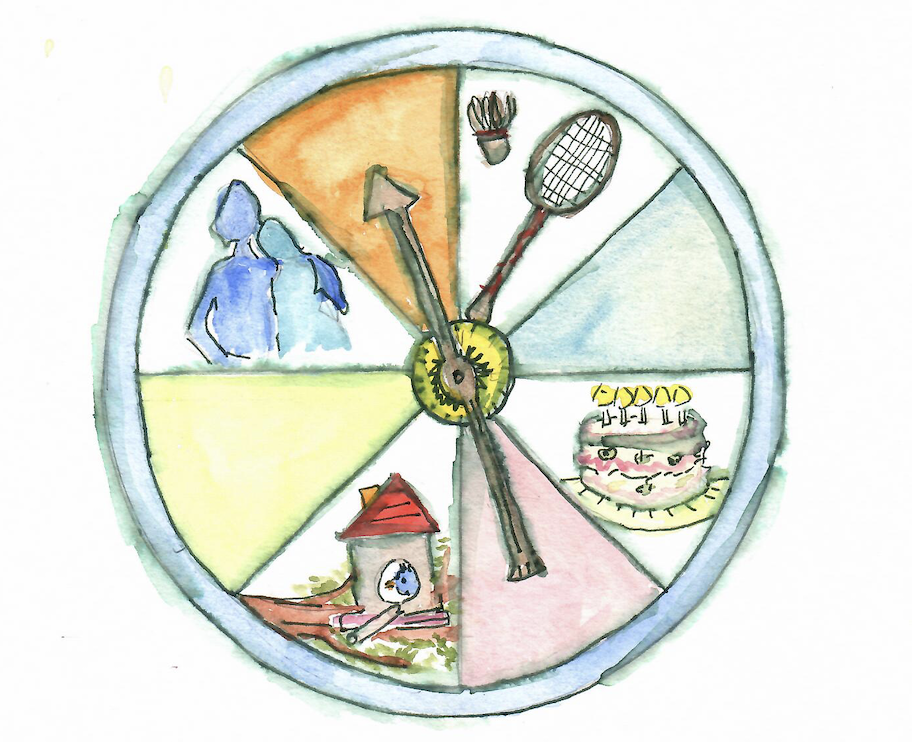
To what endeavors does your arrow point?
Having a sense of purpose in life influences our health, cognition, well-being, and even our mortality (Alimujiang et al., 2019; Sutin et al., 2024; Sutin et al., 2026). Therefore, researchers want to know more about what drives how we feel about our lives in this realm to ultimately help people who lack purpose direction. They differentiate between temporal or state-like purpose in life that fluctuates moment to moment or day to day based on the immediate context or passing moods and dispositional purpose that is more stable, trait-like, and represents an enduring outlook on life.
Research question: Is there a relationship between what we do during a day and how we feel about the purposefulness of our lives?
How researchers studied this question: Sutin and colleagues (2026) recruited couples between the ages of 40-70 from the Couples Healthy Aging Project; 308 people enrolled in the study (mean age 52 years old; 54.5% women; 24% people of color). Participants completed a 7-item purpose in life self-report measure from the Scales of Psychological Well-being (Ryff & Keyes, 1995) to characterize their dispositional purpose. Each evening for 8 consecutive days, they rated how much they felt their life had purpose that day (purpose “state”) using a sliding scale 0-100. They also provided information about whether they had engaged in various social activities, leisure activities, or other activities including worked for pay, volunteered, felt bored, cooked, house work, walking).
Answer: Yes. Six out of 22 activities were associated with how people experienced a sense of purpose at the end of the day. People tended to experience purpose in life on days when they socialized in person, took care of children, worked on a hobby, engaged in physical activity, or worked around the house. They experienced less purpose on days that they were bored and/or did not engage in social activities. Notably, working for pay and volunteering were unrelated to self-reported purpose. Same with TV, reading, and social media. Finally, people with higher dispositional purpose were more likely to feel their lives had purpose each evening. Overall, these findings align with the results of other studies that show a positive relationship between social connection, physical activity, and purpose in life.
So What? This study extends the evidence supporting that how we use our time influences our sense of purpose. Findings suggest that certain subclasses of activities (e.g., socializing in person, physical activity, caring for kids, hobbies, housework) induce a sense of purpose whereas work, passive leisure like reading, games, social media may not.
However, the study did not explore or explain how these activities related to people’s WHY. Our research presumes that people experience a sense of purpose when they use their time in ways that align with their values, strengths, and sources of personal meaning (inner Compass) – that alignment is the primary driver of purpose, not a given activity per se. In our studies, participants reported that their Compass-informed activities often included self-care, household chores, child care, creative endeavors, and simply being present with loved ones.
The upshot is this: if we spend our time in ways that reflect what matters most to us, we’re likely to feel like our lives have purpose. This is not about doing the activities on this study’s short-list but making everyday choices more often than not that align with our inner Compass, not someone else’s.
How about you? Can you list 10 ways to spend your time that align with your inner Compass? If you find that you rarely do them, how might you change that?
Sources:
Alimujiang A, Wiensch A, Boss J, Fleischer NL, Mondul AM, McLean K, Mukherjee B, Pearce CL (2019). Association Between Life Purpose and Mortality Among US Adults Older Than 50 Years. JAMA Network Open, 2(5), e194270. doi: 10.1001/jamanetworkopen.2019.4270.
Find the abstract here: https://pubmed.ncbi.nlm.nih.gov/31125099/
Ryff CD, Keyes CL (1995). The structure of psychological well-being revisited. Journal of Personality and Social Psychology, 69(4), 719–727. https://doi.org/10.1037/0022-3514.69.4.719
Find the abstract here: https://pubmed.ncbi.nlm.nih.gov/7473027/
Sutin AR, Luchetti M, Stephan Y, Terracciano A (2024). Purpose in life and cognitive health: a 28-year prospective study. International Psychogeriatrics, 36 (10), 956-964.
https://doi.org/10.1017/S1041610224000383.
Find the abstract here: https://www.sciencedirect.com/science/article/pii/S1041610225002443
Sutin AR, Luchetti M, Stephan Y, Terracciano A (2026). Daily activities and purpose in life. International Journal of Wellbeing, 16(1), 5889. doi: 10.5502/ijw.v16i1.5889.
Find the abstract here: https://pubmed.ncbi.nlm.nih.gov/42405202/
Sutin A, Zavala D, Milad E, Stephan Y, Karakose S, Brown J, Terracciano A, Luchetti M. (2026). Purpose in life and mortality: A meta-analysis of the published literature and individual-participant data of 488,765 participants followed for up to 32 years. Psychological Medicine, 8, 56:e214. doi: 10.1017/S0033291726104863.
Find the abstract here: https://pubmed.ncbi.nlm.nih.gov/42417009/